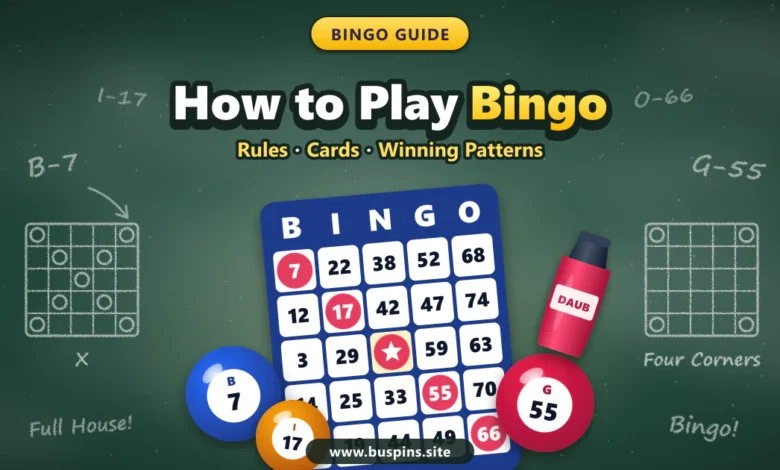
Bingo takes a minute to learn: numbers are called, you mark the ones on your card, and the first player to complete the winning pattern wins. The small details are what catch new players. A 75-ball card and a 90-ball ticket are built differently, the winning pattern can change from one round to the next, and in many halls a late call can cost you the prize.
Here you will learn how to play bingo step by step, from reading your card to calling Bingo at the right moment. The basic rules are the same at a family game night, in a bingo hall, or in a bingo app.
How to Play Bingo: Quick Guide
- The goal: mark the called numbers on your card and be the first player to complete the pattern for that game.
- 75-ball bingo: a 5×5 card with 24 numbers and a FREE space in the center. The pattern can change every game.
- 90-ball bingo: a ticket with 3 rows and 9 columns, 15 numbers in total. You can win One Line, Two Lines or a Full House.
- The FREE space: counts as already marked for every player.
- Calling Bingo: call as soon as your pattern is complete. In many halls, a claim made after the next number is called doesn’t count.
- Two winners: if two players complete the pattern on the same number, they usually share the prize.
- A wrong call: the card is checked, and the game simply continues.
How a Bingo Game Works, Step by Step
At home, in a hall or in an app, a game of bingo follows the same order:
- Get your cards. Each player has one or more cards, and every card has a different mix of numbers.
- Check the pattern. Before the first number, the caller says what you need to win: a line, a shape or the whole card.
- Listen to the calls. The caller draws numbers at random, from a ball machine or a random number generator, and reads each one out. In 75-ball bingo, the letter comes first, like “B-7” or “N-42”.
- Mark your numbers. When a called number is on your card, mark it with a dauber (a marker pen with a round sponge tip), a chip or a pen. In an app, you tap the number, or the game marks it for you.
- Call “Bingo!” As soon as your marks complete the pattern, call out loud and clear so the caller hears you.
- Wait for the check. The caller or a checker compares your marked numbers with the numbers already called. If they all match, you win.
- Play on. In 90-ball bingo, the same game continues from One Line to Two Lines and then to the Full House. In other games, a new round starts, often with a new pattern.
Playing Bingo at Home
In our team, bingo is mostly a New Year game that we play at home once or twice. A family game night needs no special equipment. You need:
- Cards: one or more for each player. You can print bingo cards, or draw 5×5 grids and fill them in with the column ranges from the table below.
- Markers: coins, buttons, dried beans or a pen.
- A way to draw numbers: a bingo ball set, numbered slips of paper in a bowl, or a random number app.
- A caller: one person who draws the numbers and reads them out.
💡 Keep the called numbers. Put each drawn ball or slip aside instead of back in the bowl. When someone calls Bingo, you can check their card in seconds.
75-Ball vs 90-Ball Bingo Cards
Most bingo games use one of two card types. 75-ball bingo is the classic game in North America, and 90-ball bingo is the main game in the UK. Here is how they compare:
| Feature | 75-ball bingo | 90-ball bingo |
|---|---|---|
| Card | 5×5 grid | 3 rows × 9 columns |
| Numbers on a card | 24 + a FREE space | 15 (5 in each row) |
| Numbers called from | 1–75 | 1–90 |
| Columns | B 1–15, I 16–30, N 31–45, G 46–60, O 61–75 | 1–9, 10–19, 20–29 … 80–90 |
| How you win | The pattern for that game | One Line, Two Lines, Full House |
How to Read a 75-Ball Card
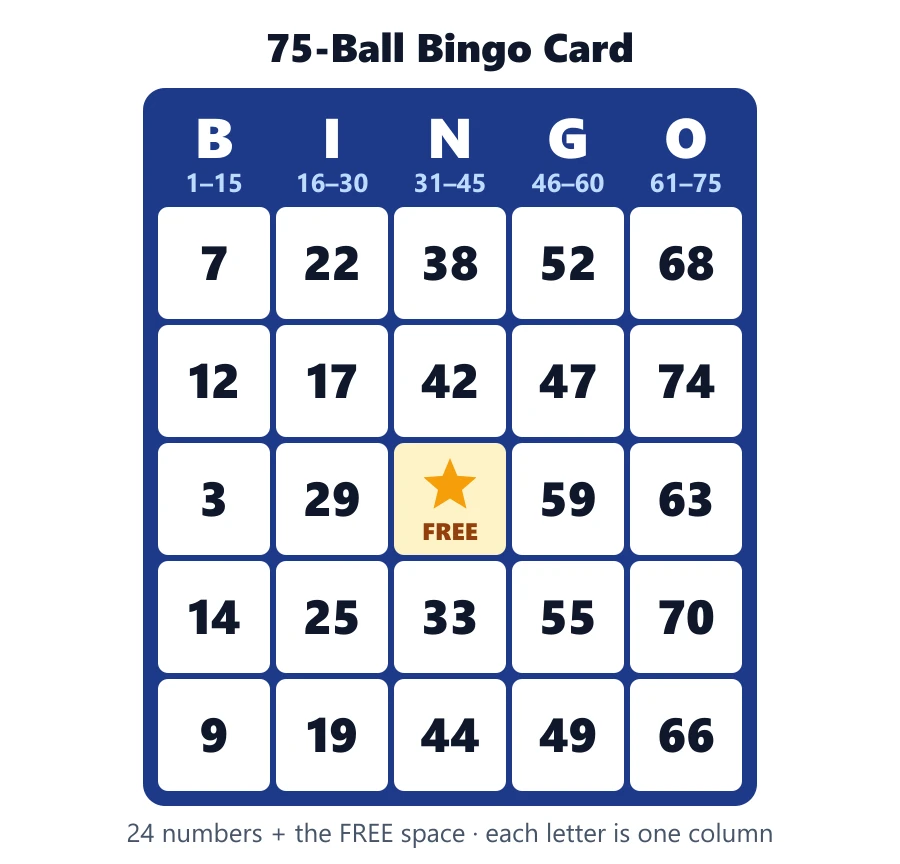
The letters B-I-N-G-O sit above the five columns, and each column holds numbers from its own range. When the caller says “G-52”, look only in the G column. That’s why callers say the letter first.
The N column has only four numbers, because the center square is the FREE space. Any line through the center needs just four called numbers.
How to Read a 90-Ball Ticket
A 90-ball ticket has 3 rows and 9 columns, but only 5 numbers in each row. The other squares are blank. The columns go by tens: the first holds 1–9, the second 10–19, and the last 80–90. So when 47 is called, look in the fifth column.
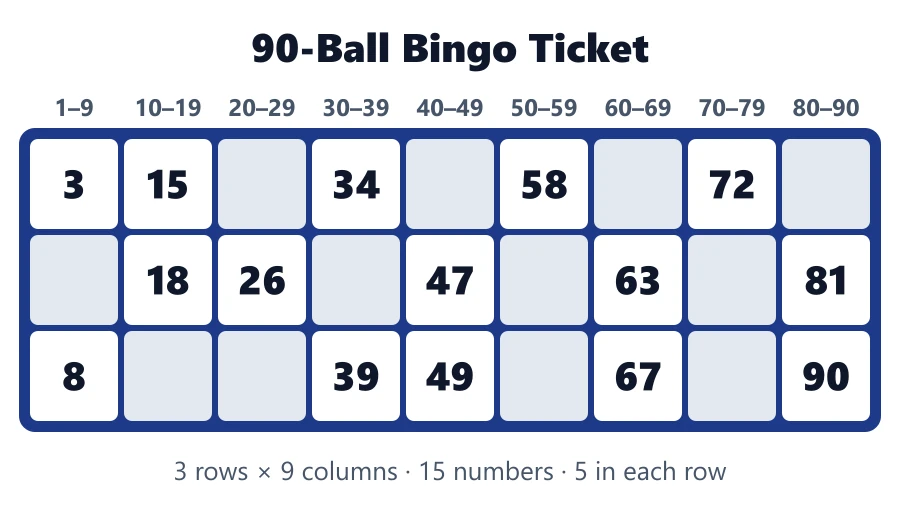
Tickets often come in a strip of six. Together, the six tickets hold every number from 1 to 90 once, so each called number is on one of your tickets.
80-Ball and 30-Ball Bingo
You will mostly find these faster versions online:
- 80-ball bingo: a 4×4 card with 16 numbers. The columns hold 1–20, 21–40, 41–60 and 61–80. Depending on the game, you win with lines, four corners or a full house.
- 30-ball bingo: also called speed bingo. A 3×3 card with 9 numbers, and usually only a full house wins, so rounds are very short.
Bingo Winning Patterns
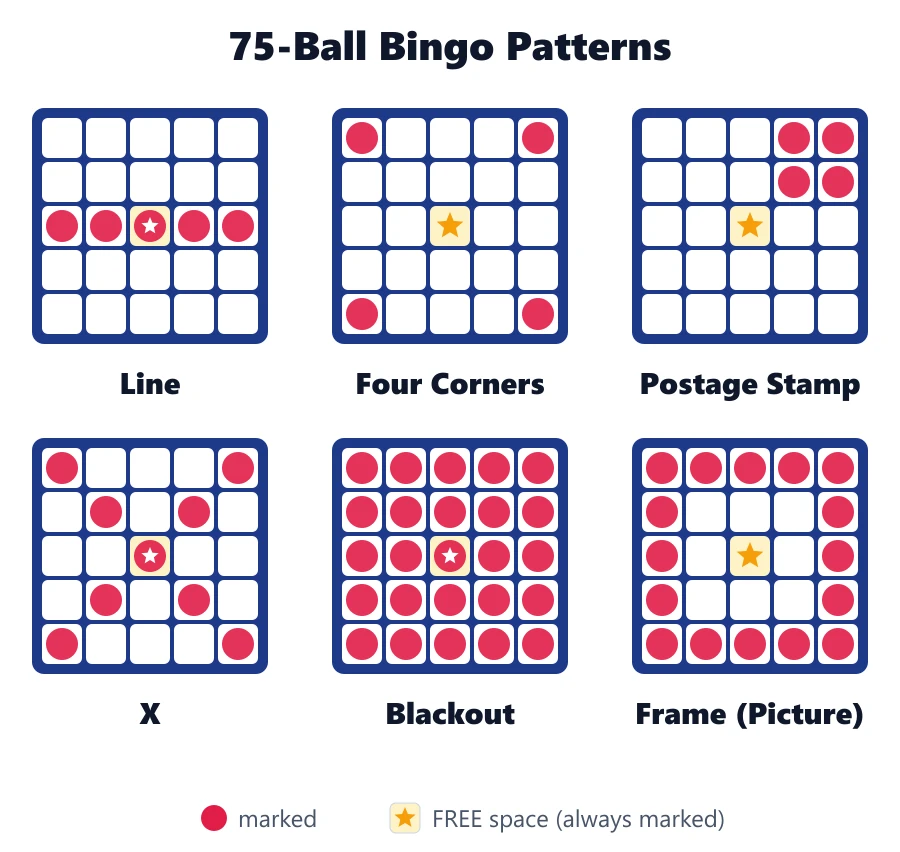
The pattern is the shape your marked numbers must make to win. Check it before every game, because in 75-ball bingo it can change from one round to the next.
75-Ball Bingo Patterns
- Line: five in a row across, down or corner to corner. A line through the center uses the FREE space.
- Four corners: just the four corner squares.
- Postage stamp: a 2×2 block in a corner of the card.
- X: both diagonals, which meet at the FREE space.
- Blackout or coverall: every square on the card, all 24 numbers plus the FREE space.
- Picture patterns: letters, a frame around the edge or other shapes. The caller shows or names the shape before the game.
90-Ball Bingo Patterns
- One Line: all 5 numbers in any one row of a ticket.
- Two Lines: any two full rows on the same ticket.
- Full House: all 15 numbers on a ticket.
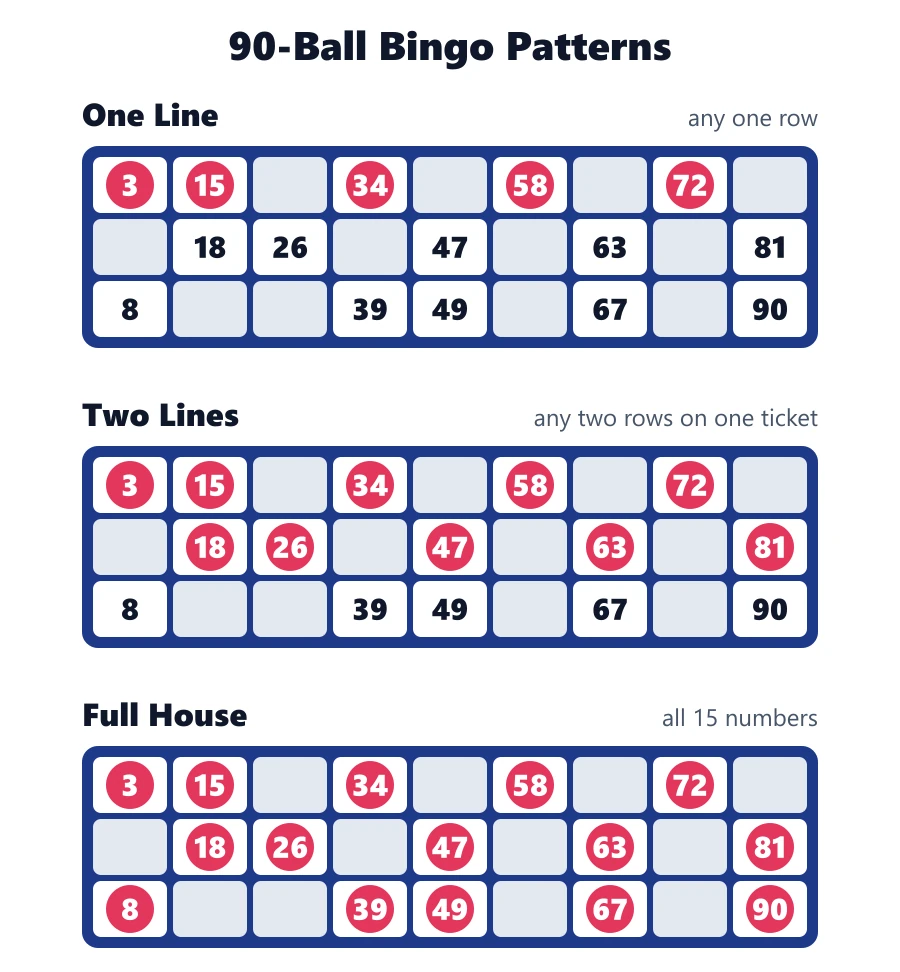
A 90-ball game usually plays the three prizes in order. The first player with a line wins the first prize, then the game goes on for two lines, and it ends with the Full House, usually the biggest prize.
⚠️ Only the announced pattern wins. A complete line doesn’t win a four corners game, and four corners don’t win a blackout game. Check the pattern before you call Bingo.
When and How to Call Bingo
Marking your numbers is only half the job. You also have to claim the win at the right moment. House rules vary, but these are the most common:
❗ Call before the next number. In many halls, a claim made after the next number is called isn’t accepted, even if your card was complete. Call as soon as you mark the last number.
- Keep your card as it is: don’t clear your marks or put the card away until the check is finished.
- The last number: some halls also require the last number called to be part of your winning pattern.
- Two or more winners: if several players complete the pattern on the same number, the prize is usually split equally between them.
- A wrong call: if a marked number on your card wasn’t called, the claim fails and the game continues.
Playing somewhere new? Ask about the house rules before the first game, especially how shared wins and late calls work.
Bingo Calls and Number Nicknames
In 75-ball bingo, the caller says the column letter and the number, like “B-7” or “O-68”. In UK 90-ball halls, callers often add a nickname for the number. Many come from rhymes or from the shape of the digits. A few classic ones:
| Number | Nickname |
|---|---|
| 1 | Kelly’s Eye |
| 11 | Legs Eleven |
| 22 | Two Little Ducks |
| 66 | Clickety-Click |
| 88 | Two Fat Ladies |
| 90 | Top of the Shop |
You don’t need to learn them. Callers usually say the plain number too, for example “Two little ducks, twenty-two”.
Playing Bingo Online and in Apps
The rules don’t change on a screen, but a few things work differently:
- The game draws the numbers: a random number generator replaces the ball machine, and each called number appears on the screen.
- Marking can be automatic: many games offer auto-daub, which marks every called number for you. In others, you tap each number yourself.
- More cards at once: it’s common to play several cards in one round.
- A BINGO button: instead of calling out, you tap a button, and the game checks your card at once.
- Free bingo apps: free-to-play bingo games use in-game currency, such as chips or coins, instead of money. Many add extras like power-ups, but the core rules stay the same: mark the called numbers and complete the pattern.
Bingo played for real money is gambling, so it is only for adults and only where local law allows it.
Want to try bingo in a different style? Bingo Bash is a free bingo app with themed Bingo Rooms, Powerplays and Mini Games, and you can play it on your phone, tablet or in a web browser. If you give it a try, our Bingo Bash free chips page has the latest free chip links.
Beginner Tips and Common Mistakes
Bingo is a game of chance: no method can predict the next number, and every card has the same chance to win. These habits help you avoid missing a win you already have:
- Start with one or two cards: more cards give you more chances to win, but also more numbers to check. Add cards once you can follow the calls easily.
- Mark every number right away: waiting to mark several numbers at once is how wins get missed.
- Use the columns: on a 75-ball card, look only under the called letter. On a 90-ball ticket, the tens of the number tell you the column.
- Don’t mark numbers you aren’t sure about: a misheard number leads to a wrong call. Many halls show the called numbers on a board or screen, so check there.
- Don’t clear your card too early: wait until the winner’s card has been checked. If their call was wrong, the game continues with your marks.
- Know what changes your odds: your chance in each game depends on how many cards are in play. Fewer players and fewer cards mean a better chance for each of your cards.
Bingo FAQ for Beginners
How many numbers are on a bingo card?
A 75-ball card has 24 numbers and a FREE space on a 5×5 grid. A 90-ball ticket has 15 numbers on 3 rows and 9 columns. Faster online games use 80-ball cards with 16 numbers and 30-ball cards with 9.
What does the FREE space mean in bingo?
It is the center square of a 75-ball card, and it counts as marked for every player from the start. It helps with any pattern that passes through the center, such as a line through the middle, an X or a blackout.
What happens if two people call Bingo at the same time?
If both cards complete the pattern on the same number, both players win, and the prize is usually split equally. House rules can differ, so ask before you play.
What happens if you call Bingo by mistake?
Your card is checked against the called numbers. If the pattern isn’t complete, the claim fails and the game continues for everyone.
Is bingo just luck?
Yes. The numbers are drawn at random, and every card has the same chance. What you control is marking every number and calling on time. More cards give you more chances, and games with fewer players give each card a better chance.
What is the difference between a blackout and a Full House?
Both mean every number on your card is marked. Blackout, or coverall, is the 75-ball name. Full House is the 90-ball name, where it is the last and usually the biggest prize of the game.
Why do bingo callers say a letter before the number?
In 75-ball bingo, each letter of B-I-N-G-O stands for one column. The letter tells you where to look: B-12 can only be in the B column.